

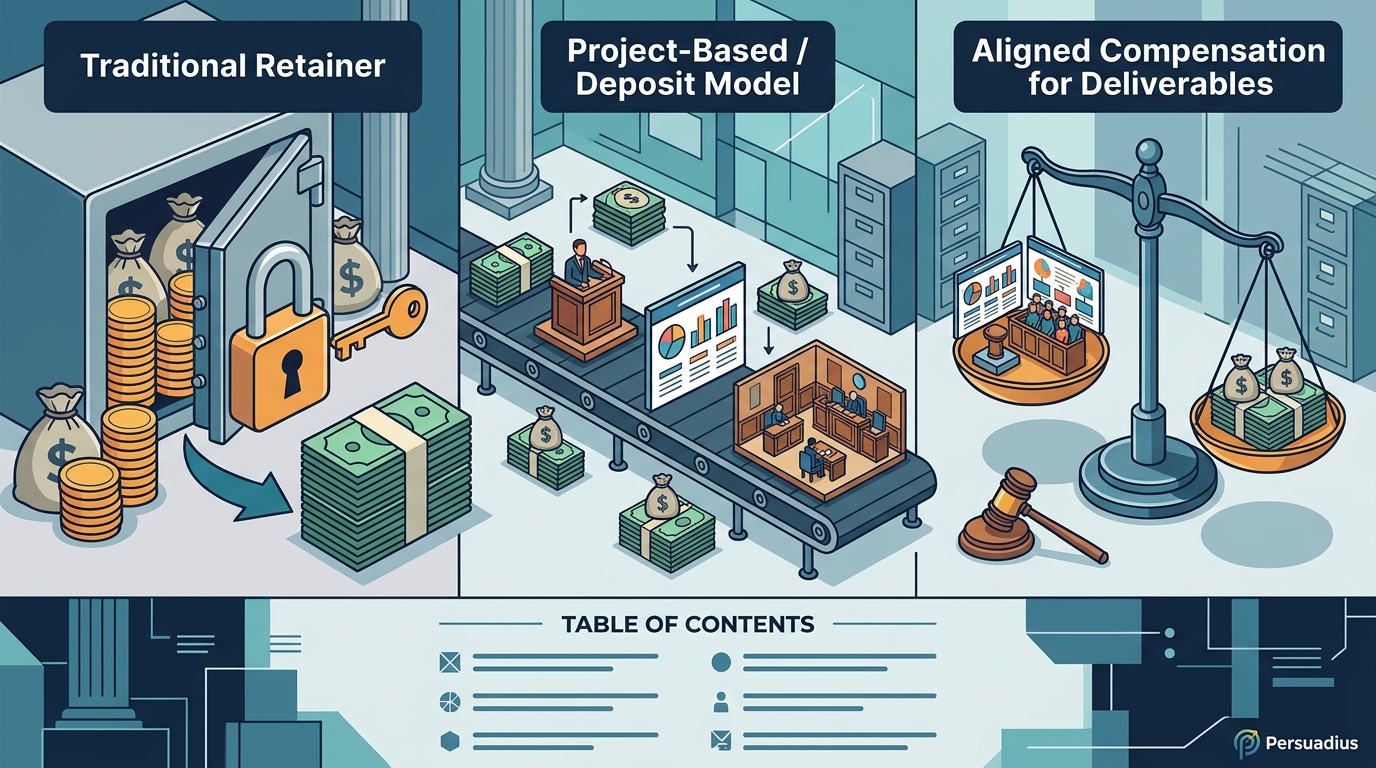
Most litigation consulting firms do not require upfront retainers in the traditional legal sense. Instead, they typically operate on a project-based or hourly billing model, often with a deposit or milestone payments. This structure aligns the consultant's compensation with the specific deliverables, such as mock trials or trial graphics, rather than a general retainer for future, undefined work.
The Standard Billing Model for Litigation Consultants
Unlike law firms that often rely on monthly retainers to secure future availability, litigation consulting firms like Persuadius generally bill for specific services rendered. This is because the scope of work is usually defined by the trial calendar and specific case needs. A project-based fee is a fixed price for a defined set of deliverables, such as a full mock trial or a set of demonstrative exhibits. This model provides clarity for both the law firm and the consultant, ensuring that costs are predictable and tied directly to the value of the work produced.
Deposits and Milestone Payments
While a traditional retainer is uncommon, many firms do request a deposit or require payments at specific milestones. This is a standard business practice to cover initial costs, such as researcher time or software licensing, before the main work begins. For example, a firm might require a 50% deposit upon signing a contract for a mock trial, with the remaining 50% due upon completion. This approach protects the consultant from non-payment while demonstrating a commitment to the project's success. It is a practical way to manage cash flow without the long-term obligations of a retainer.
Why Retainers Are Less Common in Consulting
The nature of litigation consulting is episodic rather than continuous. A firm may be hired for a mock trial six months before trial, then for graphics two months before, and for trial tech on the day of trial. There is no need to pay for availability in between these specific events. A retainer fee is a payment made in advance to secure a professional's services for a future period, which is less applicable here. Instead, firms focus on delivering high-impact results at key junctures. This allows law firms to allocate their budgets more efficiently, paying only for the expertise they need when they need it.
How to Structure Your Engagement
When engaging a litigation consultant, it is important to discuss the billing structure upfront. Ask about their standard payment terms, whether they require a deposit, and how they handle changes in scope. A clear contract outlining these terms prevents misunderstandings later. For instance, if you need to add a second mock trial, the cost should be clearly defined. This transparency is a hallmark of reputable firms like A2L, which prioritize client trust and clear communication. By understanding the financial structure, you can better plan your case budget and avoid unexpected costs.
Key Takeaways
- Most litigation consulting firms do not require traditional upfront retainers.
- Project-based fees and milestone payments are the standard billing models.
- Deposits are common to cover initial costs and secure the consultant's time.
- The episodic nature of trial preparation makes retainers less practical.
- Clear contracts and upfront discussions about billing terms are essential.
- Reputable firms prioritize transparency and predictable costs for clients.
Frequently Asked Questions
Do litigation consultants charge hourly or by the project?
Both models are common. Hourly billing is often used for ongoing consulting or undefined work, while project-based fees are preferred for specific deliverables like mock trials or graphics. The choice depends on the scope and nature of the engagement.
Is a deposit always required?
Not always, but it is a common practice. A deposit, often 25% to 50% of the total project cost, helps cover initial expenses and secures the consultant's schedule. The specific amount varies by firm and project size.
How does billing work for trial technology services?
Trial technology services, such as hot-seat operators, are often billed as a flat fee for the duration of the trial. This covers the technician's time, equipment, and setup. It is a predictable cost that does not fluctuate based on the number of exhibits shown.
Can I negotiate the billing terms?
Yes, billing terms are often negotiable, especially for large or long-term engagements. Discuss your budget constraints and preferred payment schedule with the consultant. Many firms are flexible and willing to work out a structure that fits your needs.
What happens if the case settles before the work is completed?
Do firms offer discounts for multiple services?
Some firms offer package deals or discounts if you hire them for multiple services, such as both mock trials and trial graphics. This can be a cost-effective way to ensure consistency in your trial presentation. Ask about any available bundles or loyalty discounts.