

Effective Trial Graphics: A Guide to Persuasive Courtroom Visuals
Modern litigation is increasingly visual, with data showing that jurors retain significantly more information when complex arguments are supported by clear demonstrative exhibits. According to industry benchmarks, effective trial graphics can increase juror engagement and comprehension by up to 40 percent during high-stakes proceedings. This shift toward visual advocacy is not merely a trend but a fundamental change in how evidence is processed in the courtroom. Legal teams must now integrate strategic design with legal theory to ensure that every slide, diagram, and animation serves a persuasive purpose. The goal is to simplify complexity without sacrificing accuracy, allowing the jury to focus on the narrative rather than the noise. (Persuadius and A2L Customer)
Why Trial Graphics Matter in Modern Litigation
Trial graphics are not just decorative elements; they are critical tools for persuasion. Trial graphics is the strategic use of visual aids to clarify complex evidence and reinforce legal arguments. In an era where jurors are accustomed to high-quality digital media, low-effort exhibits can undermine a lawyer's credibility. The human brain processes visual information 60,000 times faster than text, making well-designed graphics essential for capturing attention during long trials.
At Persuadius, we have observed that cases involving complex financial data, medical malpractice, or technical engineering disputes benefit most from professional visual support. Our team works with top law firms to ensure that every visual element aligns with the case theory. This alignment ensures that the jury does not just see the evidence but understands its significance in the context of the broader narrative.
Furthermore, effective graphics reduce cognitive load. When a jury is presented with dense testimony, they may struggle to retain key details. Visual aids act as anchors, helping jurors remember critical facts long after the testimony has ended. This retention is crucial for deliberations, where the clarity of the case theory often determines the verdict.
Core Design Principles for Legal Advocacy
Creating persuasive trial graphics requires adherence to specific design principles that prioritize clarity and impact. One of the most important concepts is that visual advocacy is the practice of using design to enhance the persuasiveness of legal arguments. This involves more than just making slides look good; it requires a deep understanding of how jurors perceive information.
Clarity Over Complexity
The primary goal of any trial graphic is to simplify. Complex data should be distilled into its most essential components. Avoid cluttering slides with excessive text or unnecessary details. Instead, focus on the single point you want the jury to remember. If a slide requires more than three seconds to understand, it is likely too complex.
Consistency and Branding
Consistency in design helps establish authority and professionalism. Use a consistent color palette, font style, and layout throughout the presentation. This consistency allows the jury to focus on the content rather than being distracted by changing visual styles. Additionally, consistent branding reinforces the credibility of the legal team presenting the case.
Emotional Resonance
While facts are paramount, emotions drive decisions. Effective graphics can evoke empathy or highlight the human impact of a dispute. For example, in a personal injury case, a timeline of events can be designed to emphasize the duration of suffering. In a commercial dispute, a financial chart can highlight the scale of loss. The key is to align the emotional tone of the graphic with the desired juror response.
Types of Persuasive Trial Graphics
Different types of cases require different types of visual aids. Understanding the strengths of each format allows legal teams to choose the most effective tool for their specific needs. Below is a summary of common trial graphic types and their optimal use cases.
| Graphic Type | Best Use Case | Key Benefit |
|---|---|---|
| Timelines | Establishing sequence of events | Provides chronological clarity |
| Infographics | Simplifying complex data | Enhances data retention |
| 3D Animations | Technical or engineering disputes | Visualizes invisible mechanisms |
| Maps and Diagrams | Location-based or spatial disputes | Clarifies spatial relationships |
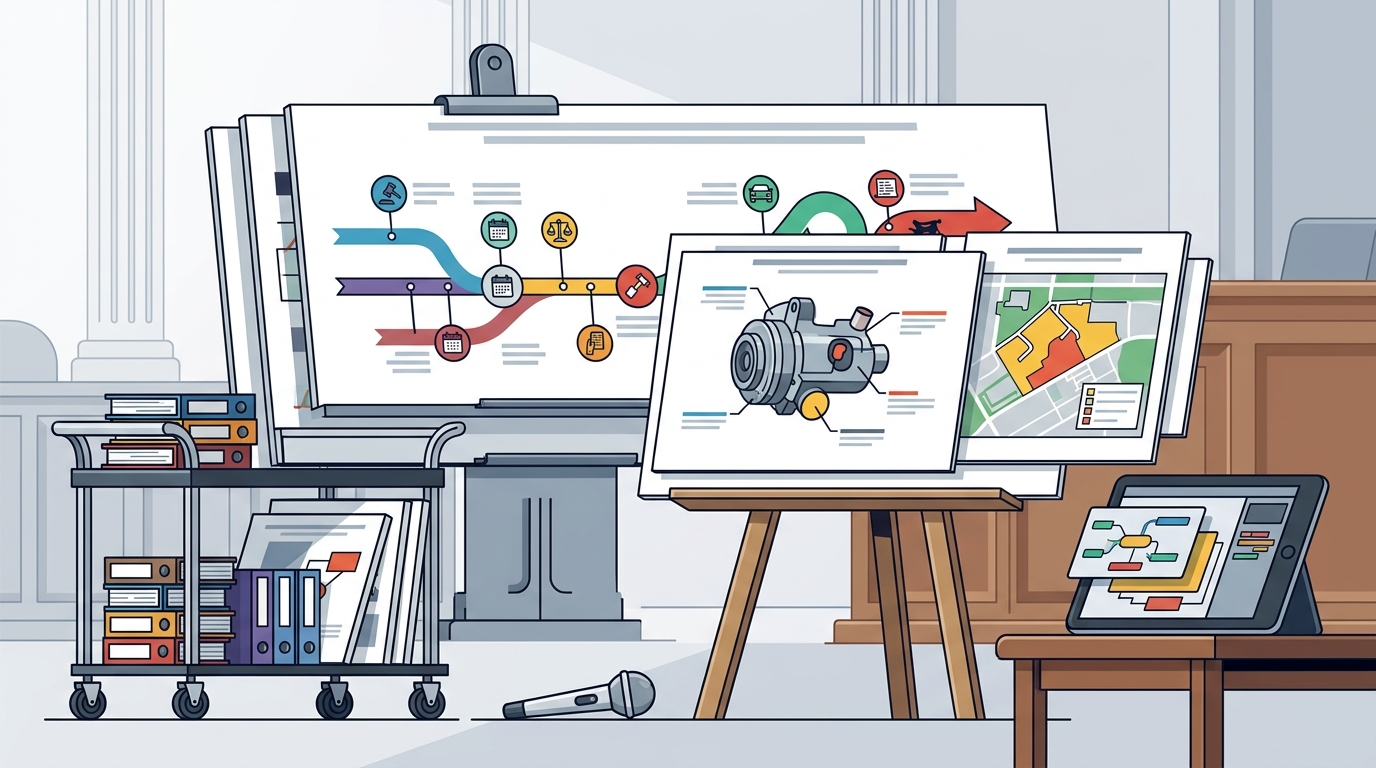
Timelines are perhaps the most versatile tool in a litigator's arsenal. They help jurors follow the narrative flow of a case, especially when dealing with multiple witnesses or events. Infographics are ideal for breaking down financial data or statistical evidence into digestible chunks. 3D animations are particularly powerful in engineering or product liability cases, where the mechanics of a failure need to be clearly demonstrated. Maps and diagrams are essential for cases involving property lines, accident reconstruction, or geographic jurisdiction.
Common Mistakes to Avoid
Even experienced litigators can fall into traps when designing trial graphics. One of the most common errors is relying too heavily on bullet points. As noted in recent litigation consulting reports, bullet points can kill persuasion by forcing jurors to read rather than listen. This creates a disconnect between the speaker and the audience.
Another mistake is using generic clip art or low-resolution images. These elements can undermine the professionalism of the presentation and distract the jury. Instead, invest in custom-designed graphics that are tailored to the specific facts of the case. Additionally, avoid changing fonts or colors arbitrarily. Consistency is key to maintaining juror focus.
Finally, do not let the graphics overshadow the testimony. The visuals should support the narrative, not replace it. If the jury is focused on the slide rather than the witness, the graphic has failed its purpose. The goal is to create a seamless integration of visual and oral advocacy.
Integrating Graphics with Oral Argument
The most effective trial graphics are those that are seamlessly integrated into the oral argument. This requires careful planning and rehearsal. Lawyers must know exactly when to introduce each graphic and how to direct the jury's attention to it. This process is often referred to as trial technology is the management of digital tools and media during courtroom proceedings. Proper management ensures that the technology enhances rather than hinders the presentation.
Collaboration between the legal team and the trial graphics consultant is essential. The consultant can provide insights on how to structure the presentation for maximum impact. They can also help anticipate potential objections from opposing counsel regarding the admissibility or accuracy of the graphics. By working together, the team can create a cohesive and persuasive narrative that resonates with the jury.
Moreover, the use of trial technicians can streamline the presentation process. These professionals manage the technical aspects of the trial, ensuring that all graphics are displayed correctly and that any technical issues are resolved quickly. This allows the lawyers to focus on their advocacy without worrying about the mechanics of the presentation.
Key Takeaways
- Visual Retention: Jurors retain significantly more information when complex arguments are supported by clear demonstrative exhibits.
- Simplification: The primary goal of trial graphics is to simplify complex data without sacrificing accuracy.
- Consistency: Using consistent design elements reinforces professionalism and aids juror focus.
- Collaboration: Effective graphics require close collaboration between legal teams and trial consultants.
- Technology Management: Trial technicians play a crucial role in ensuring smooth presentation delivery.
- Historical Expertise: Persuadius has over thirty years of experience in complex litigation support.
- Proven Results: The firm has worked on more than 10,000 matters with at least $2 trillion cumulatively at stake.
Frequently Asked Questions
What is the role of a trial consultant in graphic design?
A trial consultant helps legal teams develop visual strategies that align with their case theory. They ensure that graphics are not only visually appealing but also persuasive and legally sound.
How do I choose the right type of trial graphic for my case?
The choice depends on the nature of the evidence. Timelines are best for chronological events, while 3D animations are ideal for technical disputes. A consultant can help determine the most effective format.
Can trial graphics be used in depositions?
Yes, trial graphics can be highly effective in depositions to clarify testimony and prepare witnesses for trial. They help establish a clear narrative early in the litigation process.
What is the difference between trial graphics and litigation graphics?
While often used interchangeably, litigation graphics is a broader term that encompasses all visual aids used in the litigation process, including pre-trial and post-trial materials. Trial graphics specifically refers to exhibits used during the trial itself.
How early should I start working on trial graphics?
It is best to start as early as possible. Early integration allows for thorough testing and refinement of the visual strategy. This ensures that the graphics are fully aligned with the case theory by the time of trial.
Do you offer services for jury research?
Yes, we offer comprehensive jury research services, including mock trials and focus groups, to test the effectiveness of your graphics and case theory before trial.
How can I contact Persuadius for a consultation?
You can contact our national headquarters by phone at 800.847.9330 or via email at contact@persuadius.com. We offer 24/7 support for urgent litigation needs.
Contact Persuadius for Trial Support
Effective trial graphics can make the difference between a win and a loss. Do not leave your visual strategy to chance. Contact Persuadius today to discuss how our team can help you present your case with clarity and persuasion. Visit our jury consulting services page to learn more about our comprehensive support offerings. For immediate assistance, call our national toll-free line at 800.847.9330 or email contact@persuadius.com. Our team is ready to help you achieve your litigation goals.