
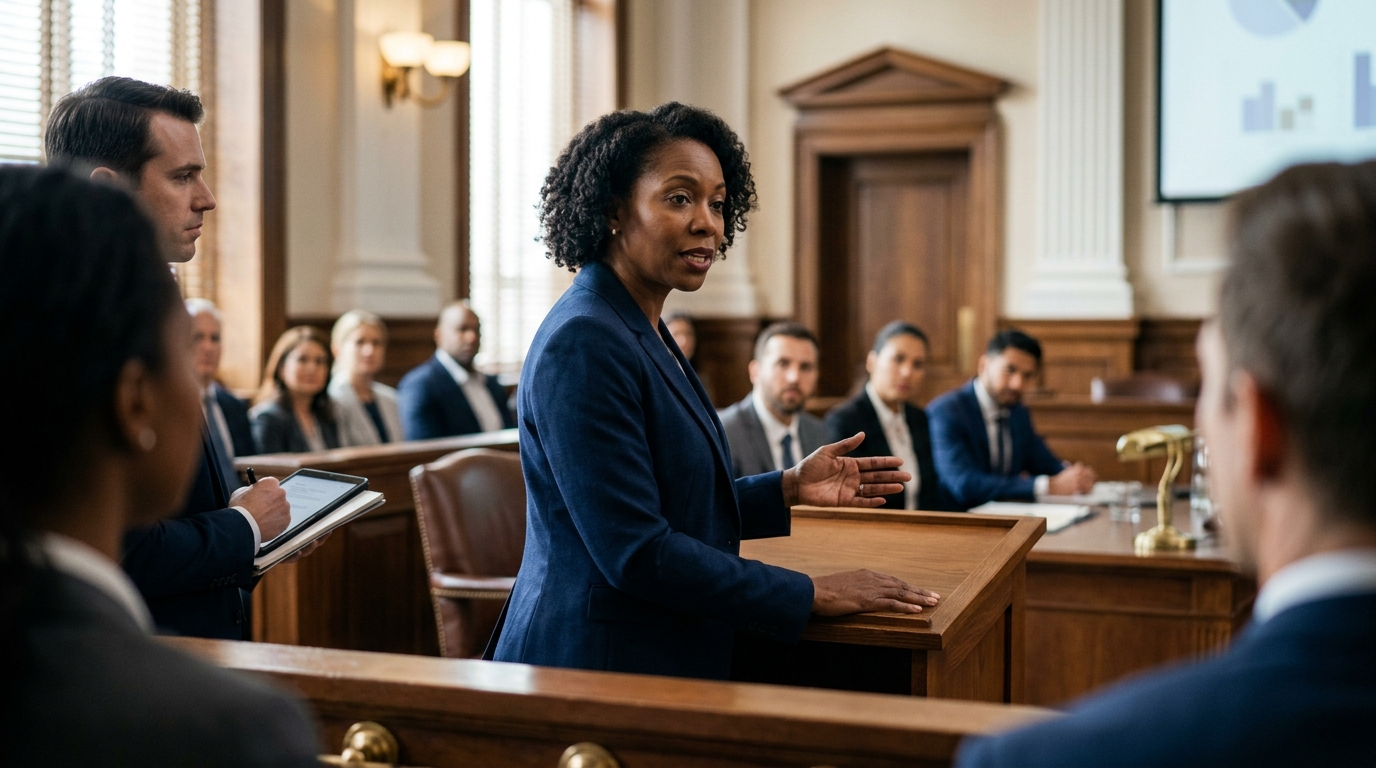
The opening statement is the single most critical moment in a trial. It sets the narrative frame that jurors will use to interpret every piece of evidence presented later. Research in legal psychology indicates that jurors form initial impressions within the first few minutes of hearing a case, and these early anchors heavily influence their final verdict. According to data from the American Bar Association, effective storytelling in opening statements can significantly increase the likelihood of a favorable outcome by reducing cognitive load for the jury. This guide details the proven methodologies used by top litigation consultants to craft opening statements that persuade rather than just inform. (Persuadius and A2L Customer)
The Science of Narrative Structure
An effective opening statement is not a chronological list of facts. It is a carefully constructed story that aligns with the legal elements of the case. Jurors are natural storytellers; they crave coherence and causality. When you present disjointed facts, you force the jury to do the heavy lifting of connecting the dots. This cognitive effort often leads to confusion or disengagement. (Persuadius Nationwide Jury Consulting)
Narrative is the framework for truth. By providing a clear, logical sequence of events, you guide the jury to your desired conclusion without them realizing they are being led. This approach is rooted in the "Story Model" of juror decision-making, which posits that jurors evaluate cases by comparing the plaintiff's or defendant's story against their own experiences and expectations.
To build this narrative, start with a strong hook. Avoid dry legal jargon. Instead, introduce the central conflict immediately. For example, in a product liability case, do not start with the history of the corporation. Start with the moment the product failed and the human cost that followed. This emotional connection creates a bridge between the abstract legal standards and the concrete reality of the jury's life.
Furthermore, the structure must be simple. Complex legal theories should be distilled into plain language. If you cannot explain your case to a 10-year-old, you do not understand it well enough to present it to a jury. Clarity is the highest form of sophistication in the courtroom. By simplifying the message, you ensure that your core argument remains intact even when the jury is tired or distracted.
Leveraging Litigation Graphics
Visual aids are not merely decorative; they are persuasive tools that enhance memory retention and comprehension. Studies show that people remember 80% of what they see and do, compared to only 20% of what they read. In the context of a trial, this means that a well-designed graphic can be more persuasive than hours of verbal testimony.
However, not all graphics are created equal. The best litigation graphics are those that simplify complexity without sacrificing accuracy. They should highlight the key points of your argument and eliminate visual noise. For instance, in a complex commercial dispute, a timeline graphic can clarify the sequence of events more effectively than a stack of documents.
At Persuadius, we specialize in creating demonstrative exhibits that capture the essence of your presentation. Our team works closely with attorneys to ensure that every visual element serves a strategic purpose. Whether it is a 3D animation of an accident scene or a simplified chart of financial transactions, the goal is to make the invisible visible and the complex clear.
It is also crucial to introduce your graphics early and often. Do not wait until the trial to reveal your visual strategy. Use them in the opening statement to set the stage. When the jury sees a graphic that matches your verbal narrative, it reinforces the message and builds credibility. This consistency between what you say and what you show is vital for establishing trust with the jury.
Psychological Anchoring Techniques
Psychological anchoring is a cognitive bias where individuals rely too heavily on the first piece of information offered (the "anchor") when making decisions. In a trial, your opening statement serves as the primary anchor for the entire case. If you establish a strong, favorable anchor early on, it becomes difficult for the opposing counsel to shift the jury's perspective later.
One effective technique is to frame the burden of proof in your favor. Instead of letting the jury wonder what the standard is, clearly define it in simple terms. For example, "Beyond a reasonable doubt" is a legal term, but explaining it as "a doubt based on reason and common sense" makes it more accessible. This framing helps the jury understand what they need to find to return a verdict for your side.
Another anchoring strategy is to pre-emptively address the weaknesses in your case. By acknowledging the opposing argument and dismantling it early, you remove its power. This technique, known as "inoculation," makes the jury more resistant to the opposing counsel's attempts to use those same points against you later. It shows confidence and honesty, which are key components of credibility.
Additionally, use repetition strategically. Repeat your core theme throughout the opening statement. This repetition reinforces the anchor and ensures that the jury remembers your main point. However, avoid mechanical repetition. Instead, vary the language while keeping the core message consistent. This keeps the presentation engaging while still driving home your key points.
Avoiding Common Persuasion Pitfalls
Even experienced attorneys can fall into traps that undermine their opening statements. One of the most common pitfalls is overloading the jury with too much information. Jurors have limited attention spans, and bombarding them with details can lead to information overload. Instead, focus on the most critical facts that support your narrative. Less is often more.
Another pitfall is using bullet points in PowerPoint presentations. As noted in recent litigation consulting reports, bullet points can kill persuasion by breaking the narrative flow. They encourage a list-like mentality rather than a story-like one. Jurors are more engaged when they are listening to a story rather than reading a list. Use full sentences and cohesive paragraphs to maintain the narrative thread.
Additionally, avoid arguing the case in the opening statement. The opening is for telling the story, not for debating the evidence. Save your arguments for the closing argument. If you argue too early, you may alienate the jury or give the opposing counsel a chance to rebut points that haven't been fully established yet. Trust the process and let the evidence speak for itself.
Finally, be mindful of your tone. Your tone should be confident, respectful, and professional. Avoid being aggressive or confrontational, as this can make the jury view you as hostile or untrustworthy. Instead, adopt a tone of calm authority. You are the guide who is helping the jury navigate the complexities of the case. Your demeanor should reflect that role.
Validating Strategy with Mock Trials
One of the most effective ways to refine your opening statement is to test it with a mock jury. Mock trials provide valuable feedback on how your narrative is being received. They can reveal which parts of your story are resonating and which parts are confusing or unconvincing. This feedback loop is essential for optimizing your strategy before the actual trial.
At Persuadius, we conduct comprehensive mock trials and focus groups to help attorneys fine-tune their presentations. Our team of jury consultants and psychologists analyzes the feedback to identify areas for improvement. We look at everything from the clarity of the narrative to the effectiveness of the visual aids. This data-driven approach ensures that your opening statement is as persuasive as possible.
Mock trials also allow you to test different versions of your opening statement. You can compare the impact of different hooks, different structures, and different visual aids. This comparative analysis helps you choose the most effective approach. It is better to make mistakes in a mock trial than in the actual courtroom.
Furthermore, mock trials can help you anticipate the opposing counsel's strategy. By simulating the opposition's arguments, you can prepare your rebuttals in advance. This preparation gives you a significant advantage during the actual trial. You will be able to respond to the opposition's points with confidence and precision.
Key Takeaways
- Narrative is King: Jurors decide cases based on stories, not just facts. Structure your opening as a coherent narrative with a clear beginning, middle, and end.
- Visuals Enhance Memory: Use litigation graphics to simplify complex information and reinforce your verbal message. Visuals should be introduced early and often.
- Anchor Early: Establish your core theme and burden of proof in the first few minutes to set the frame for the entire trial.
- Avoid Bullet Points: Text-heavy slides and bullet points disrupt narrative flow. Use full sentences and cohesive paragraphs to maintain engagement.
- Test with Mock Trials: Validate your opening statement with a mock jury to identify weaknesses and optimize your strategy before trial.
- Pre-empt Weaknesses: Address potential counterarguments early to inoculate the jury against the opposition's tactics.
- Keep it Simple: Distill complex legal theories into plain language. If you can't explain it simply, you can't persuade effectively.
Frequently Asked Questions
How long should an opening statement be?
The length of an opening statement can vary depending on the complexity of the case and local court rules. However, the general rule is to be as concise as possible while still covering all necessary points. Aim for 10 to 20 minutes for most cases. If the case is highly complex, you may need more time, but avoid rambling. Every minute should add value to your narrative.
Can I use exhibits during my opening statement?
Yes, you can use exhibits during your opening statement, but you must follow the court's rules regarding their admission. In many jurisdictions, exhibits shown during the opening are considered evidence. Therefore, you must be prepared to introduce them formally later in the trial. Use exhibits to clarify your story, not to overwhelm the jury with data.
What is the most important part of an opening statement?
The most important part is the hook. The first few seconds set the tone for the entire trial. If you can capture the jury's attention and interest immediately, you are more likely to keep them engaged throughout the presentation. Your hook should be relevant, compelling, and directly related to your core theme.
How do I handle opposing counsel's objections during my opening?
If opposing counsel objects, pause and listen to the judge's ruling. If the objection is sustained, move on to the next point without arguing. Arguing with opposing counsel or the judge can annoy the jury and damage your credibility. Stay focused on your narrative and avoid getting sidetracked by procedural disputes.
Should I mention the evidence in my opening statement?
Yes, you should mention the evidence, but do so in the context of your story. Tell the jury what you expect the evidence to show and how it supports your narrative. This "preview of proof" helps the jury understand the relevance of the evidence as it is presented. It also holds you accountable to your story, which builds trust with the jury.
How can I make my opening statement more memorable?
Use repetition, vivid language, and relatable analogies. Repeat your core theme throughout the statement to reinforce it. Use vivid language to create mental images for the jury. And use analogies to connect complex legal concepts to everyday experiences. These techniques make your opening statement more engaging and easier to remember.
What role does jury consulting play in crafting an opening statement?
Jury consulting provides data-driven insights into how different demographics and psychographics respond to various narrative structures and visual aids. By testing your opening statement with a mock jury, you can identify which parts are most persuasive and which need adjustment. This feedback allows you to tailor your presentation to the specific jury you will face.
Contact Persuadius for Trial Support
Preparing an effective opening statement requires more than just legal knowledge. It requires a deep understanding of human psychology, narrative structure, and visual persuasion. At Persuadius, we combine these disciplines to help you win your case. Our team of jury consultants, trial graphics experts, and litigation strategists is ready to assist you.
Contact us today to schedule a consultation. We offer 24/7 support for last-minute questions and conflicts checks. Visit our Contact Page to get in touch. You can also explore our Jury Consulting Services to learn more about how we can help you. For insights on trial technology, check out our Litigation Consulting Report.