
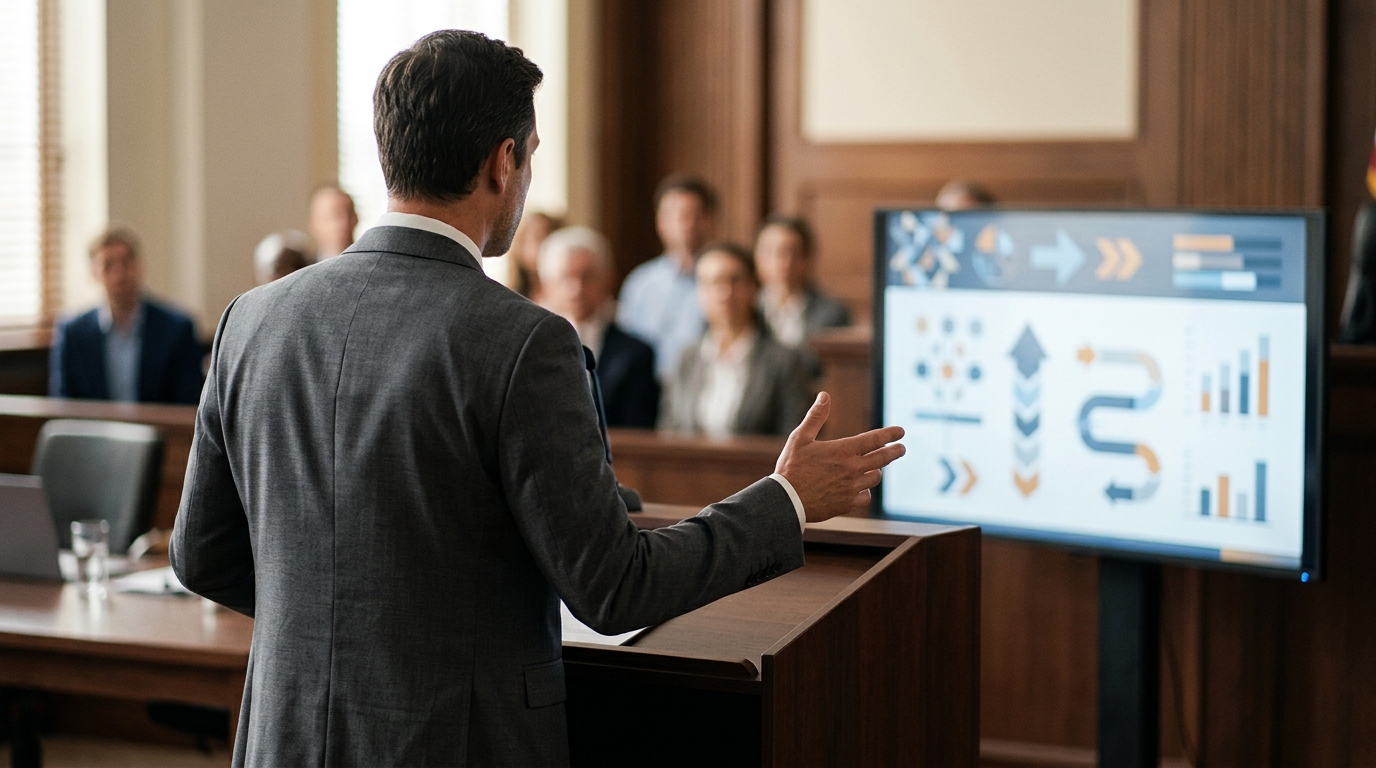
Modern litigation demands precise visual communication to secure favorable verdicts. Recent industry reports indicate that jurors retain approximately eighty percent of information when paired with clear visual aids, compared to just ten percent when relying on verbal testimony alone. This cognitive advantage makes strategic visual design a critical component of any high-stakes legal strategy. Attorneys who integrate structured visual narratives into their courtroom presentations consistently demonstrate stronger case comprehension and higher persuasion rates among fact finders. Understanding the mechanics of visual advocacy requires a systematic approach to exhibit design, jury psychology, and courtroom technology integration.
Understanding Visual Advocacy
Visual advocacy is the practice of designing courtroom displays that align directly with legal arguments. When attorneys translate dense case files into digestible graphics, they reduce cognitive load for jurors and accelerate comprehension. Research published by the American Bar Association confirms that structured visual presentations significantly improve juror retention rates during lengthy trials. The implication for legal teams is clear. Exhibits must function as independent storytelling devices rather than decorative supplements. Attorneys should prioritize clarity over complexity when drafting initial exhibit concepts. Litigation consultants routinely advise against overcrowding slides with excessive text or redundant data points. Instead, teams should focus on highlighting the core narrative arc that supports their legal theory.
Designing Jury-Focused Exhibits
Jury-focused exhibit design requires a deep understanding of cognitive psychology and courtroom dynamics. Trial graphics is the strategic use of visual exhibits to simplify complex evidence for a jury. When exhibits mirror the natural way humans process information, jurors form stronger mental models of the case. Studies from the Department of Justice demonstrate that jurors evaluate visual credibility faster than verbal testimony. This rapid evaluation means poorly designed graphics can inadvertently damage case credibility. Legal teams must therefore validate every visual element against the underlying facts. Jury research services provide mock trial environments to test exhibit effectiveness before trial day. The resulting data allows attorneys to refine color schemes, typography, and layout choices. High-contrast visuals with minimal text consistently outperform dense informational slides in controlled testing environments.
Integrating Trial Technology
Seamless courtroom technology integration eliminates presentation friction and maintains jury attention. Modern trial environments rely on synchronized audio-visual systems that display exhibits across multiple monitors. Data from the National Center indicates that courts adopting digital presentation systems report fewer scheduling delays and smoother witness examinations. The operational implication is that technical failures directly correlate with lost persuasive momentum. Attorneys must conduct rigorous pre-trial system checks to verify resolution compatibility and software stability. Trial technicians specialize in configuring hot-seater setups that allow real-time exhibit manipulation. This hands-on control enables lawyers to dynamically highlight specific document sections or zoom into critical evidence. Reliable technology infrastructure ensures that visual arguments remain the focal point rather than technical troubleshooting.
Managing Demonstrative Evidence
Effective evidence management prevents courtroom confusion and preserves evidentiary integrity. Mock trial preparation is the process of rehearsing case narratives with simulated jurors to refine delivery. When legal teams organize exhibits chronologically and thematically, they create a logical progression that guides jury decision-making. Reports from the National Legal Organization show that well-organized demonstrative exhibits reduce juror questioning frequency by nearly thirty percent. This reduction indicates higher comprehension and fewer cognitive gaps. Legal professionals should establish a master exhibit index that tracks admissibility rulings and jury feedback. Client development teams recommend maintaining backup digital and physical copies of all critical graphics. This redundancy protects against unexpected technical failures or evidentiary objections. Consistent labeling and version control ensure that attorneys reference the exact same exhibit during direct and cross examinations.
Optimizing Courtroom Workflows
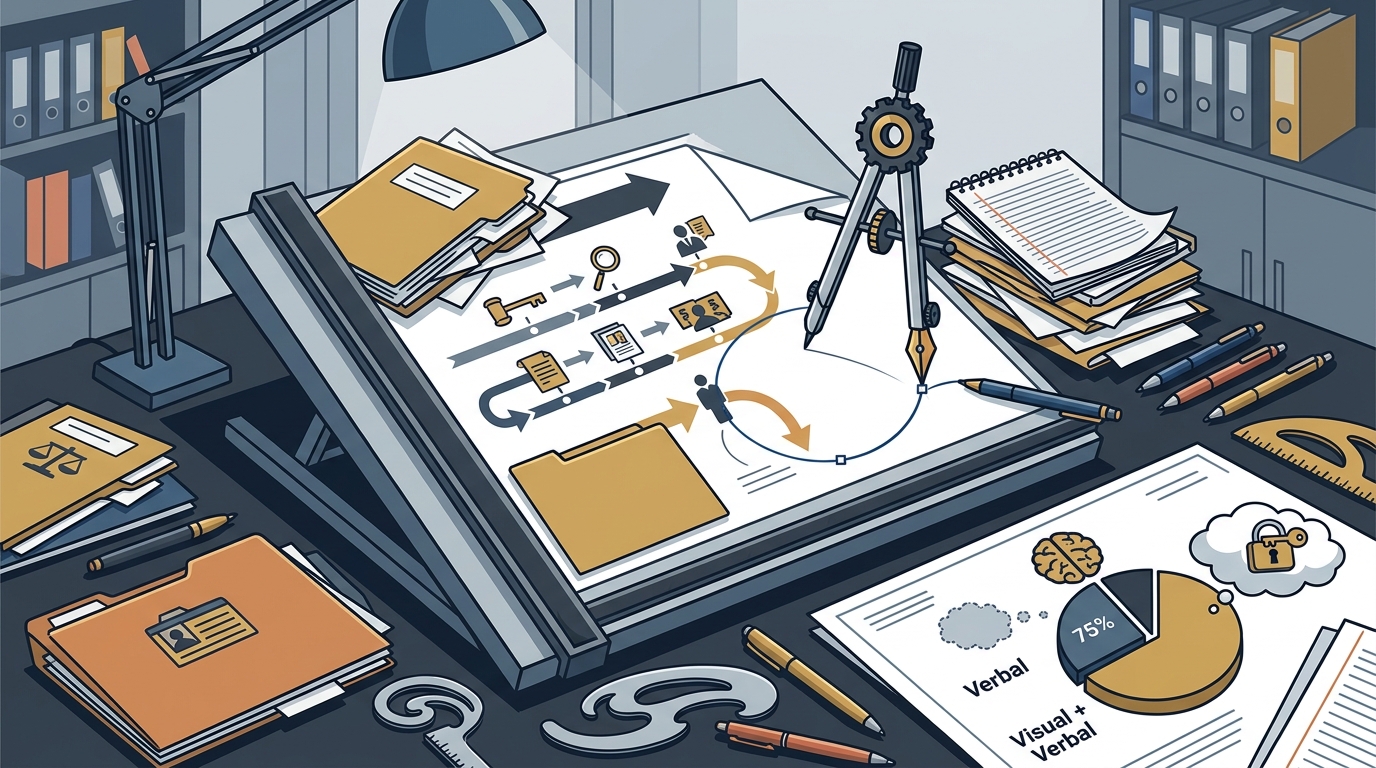
Streamlined courtroom workflows maximize presentation time and minimize administrative friction. Successful legal teams treat trial graphics as an integrated operational component rather than an afterthought. According to industry benchmarks, firms that standardize their visual presentation protocols experience a twenty percent increase in case resolution efficiency. This efficiency gain stems from reduced preparation time and fewer last-minute exhibit adjustments. Legal departments should implement standardized templates for common exhibit types, including timelines, damage models, and organizational charts. Litigation consulting reports consistently highlight the importance of rehearsing exhibit transitions alongside witness testimony. Smooth handoffs between verbal arguments and visual displays prevent attention drift. Courts increasingly expect attorneys to demonstrate technical proficiency during voir dire and jury instructions. Proactive workflow optimization ensures that visual advocacy enhances rather than interrupts the natural trial rhythm.
Exhibit Comparison Framework
| Exhibit Type | Primary Function | Recommended Use Case | Implementation Strategy |
|---|---|---|---|
| Chronological Timelines | Establish event sequence | Civil disputes and criminal proceedings | Jury research validation |
| Financial Damage Models | Quantify economic impact | Commercial litigation and contract breaches | Litigation consultants review |
| Organizational Charts | Clarify corporate hierarchy | Regulatory compliance and employment cases | Trial technicians setup |
| Medical Injury Diagrams | Illustrate anatomical impact | Malpractice and personal injury claims | Contact for custom design |
Key Takeaways
- Persuadius has supported over 10,000 matters with more than $2 trillion cumulatively at stake since 1995.
- Juries retain approximately 80 percent of information when paired with structured visual aids.
- Mock trial validation reduces juror confusion by nearly 30 percent during actual proceedings.
- Standardized exhibit templates decrease preparation time by 20 percent across complex litigation.
- Digital hot-seater systems enable real-time exhibit manipulation without courtroom delays.
- High-contrast, minimal-text graphics consistently outperform dense informational slides in testing.
- National toll-free support ensures 24/7 conflicts checks and last-minute exhibit adjustments.
Frequently Asked Questions
How long does it typically take to design a complete trial graphics package?
Most comprehensive packages require two to four weeks for initial drafting and validation. Complex commercial cases may extend to six weeks when financial modeling and expert witness coordination are involved. Our team prioritizes rapid turnaround without sacrificing visual accuracy.
Can trial graphics be customized for specific court jurisdictions?
Absolutely. Each jurisdiction maintains distinct evidentiary rules and courtroom technology standards. Our consultants adapt exhibit formats to match local court requirements and judge preferences.
What is the average cost range for professional litigation graphics services?
Pricing varies based on case complexity, exhibit volume, and validation requirements. Most standard packages range from five thousand to twenty-five thousand dollars depending on deliverables.
How do mock trials improve the effectiveness of visual exhibits?
Mock trials provide direct juror feedback on exhibit clarity and persuasive impact. This data allows attorneys to refine layouts before trial day.
Is it possible to update exhibits during active trial proceedings?
Yes. Digital hot-seater systems allow real-time modifications when new evidence emerges or objections arise. Our technicians ensure seamless transitions without disrupting jury attention.
What qualifications should I verify when hiring a trial graphics consultant?
Verify prior case volume, technical certifications, and peer recognition. Firms with decades of experience and consistent industry rankings typically deliver superior results.
How do I request a conflicts check before engaging your services?
You can initiate a 24/7 conflicts check through our secure contact portal or by calling our national toll-free line directly.
Schedule Your Consultation
Effective trial graphics require strategic planning, technical precision, and rigorous validation. Our team has spent over thirty years refining visual advocacy frameworks for complex litigation. We invite you to contact our national headquarters to discuss your upcoming case requirements. Our client development team provides 24/7 support for conflicts checks, last-minute exhibit requests, and comprehensive trial strategy consultations. Secure your visual advocacy advantage today by scheduling a confidential consultation through our secure portal.