

An opening statement is the first opportunity a trial lawyer has to speak directly to the jury and frame the entire case. Research consistently shows that up to 80 percent of jurors form their initial opinion about a case during the opening statement, making it arguably the single most important moment in any trial. Whether you handle complex commercial litigation, product liability, or intellectual property disputes, mastering the art of the opening statement can determine the outcome before a single witness takes the stand. This guide covers the psychology, structure, storytelling techniques, and visual strategies that separate winning openings from forgettable ones.
Why Opening Statements Matter More Than Any Other Phase
An opening statement is the initial presentation a lawyer makes to the trier of fact, serving as a roadmap for how the evidence will unfold. Unlike closing arguments, where attorneys can draw inferences, the opening is limited to stating what the evidence will show. Yet its influence on the verdict is disproportionately large.
As the Persuadius litigation consulting team has noted, jury research shows that as many as 80 percent of jurors make up their mind immediately after hearing the opening statements. Attention levels peak at this moment, biases are formed or overcome, and each side has its best chance to establish credibility.
The Psychology Behind Juror Decision-Making
Confirmation bias is a cognitive tendency in which people seek information that supports their existing beliefs while disregarding contradictory evidence. Once jurors form an early impression during the opening, they spend the rest of the trial filtering evidence through that lens. This is why jury consulting is so valuable: it helps trial teams understand how their narrative lands before twelve strangers decide the verdict.
According to the American Bar Association, jurors often base their decisions about disputes on the impression received during an opening statement. People also naturally pick someone to root for early in any conflict, which means the attorney who tells the more compelling human story first holds a significant psychological advantage.
Primacy Effect
The primacy effect is a memory phenomenon where people remember the first information they receive more vividly than later details. In the courtroom, this means the themes and images you introduce in your opening will anchor how jurors perceive every subsequent witness and exhibit.
Emotional Connection
People buy on emotion and justify with facts. As Persuadius's analysis of Cialdini's principles of persuasion explains, the opening is when you give jurors an opportunity to pick a side and the motivation to fight for that side during deliberations.
Storytelling: The Core of a Persuasive Opening
The most effective opening statements are built on narrative, not chronology. Trial advocacy expert Thomas Mauet identifies three key aspects of courtroom storytelling: focus on people rather than the problem, recreate scenes with vivid imagery, and organize the story simply and logically.
At Persuadius, consultants help litigators move beyond bare timelines to narratives that let jurors feel the human stakes. Persuasive storytelling works for plaintiff and defense teams alike because it transforms abstract facts into a coherent account jurors can remember and repeat during deliberations.
Develop a One-Sentence Theme
A trial theme is a concise, emotionally resonant phrase that captures the moral core of your case. The ABA recommends that lawyers develop a one-sentence theme because emotionally based themes serve as anchors that linger until the verdict is decided.
Address Weaknesses Head-On
Acknowledging unfavorable facts in your opening builds credibility. Disclose the difficult evidence on your own terms so the opposing side cannot weaponize it as a surprise. This technique, known as inoculation, increases juror trust because it signals honesty.
How to Structure Your Opening Statement
A well-organized opening follows a clear arc. The table below compares two common structural approaches and their strengths.
| Approach | Description | Best For | Risk |
|---|---|---|---|
| Chronological | Events told in time order from start to finish | Simple fact patterns, contract disputes | Can feel dry if not paired with vivid detail |
| Thematic / Story-First | Leads with the human conflict, then weaves in the timeline | Complex cases, tort claims, high-emotion matters | Requires skilled narrative to avoid confusion |
Regardless of approach, effective openings share a proven sequence: introduce yourself and your client briefly, state the theme, tell the story with key facts, preview the evidence, and close with a confident statement about the verdict you will ask for. The WHY-HOW-WHAT framework popularized by Simon Sinek applies powerfully here: lead with the reason the case matters before diving into mechanics.
Using Trial Graphics and Visual Aids
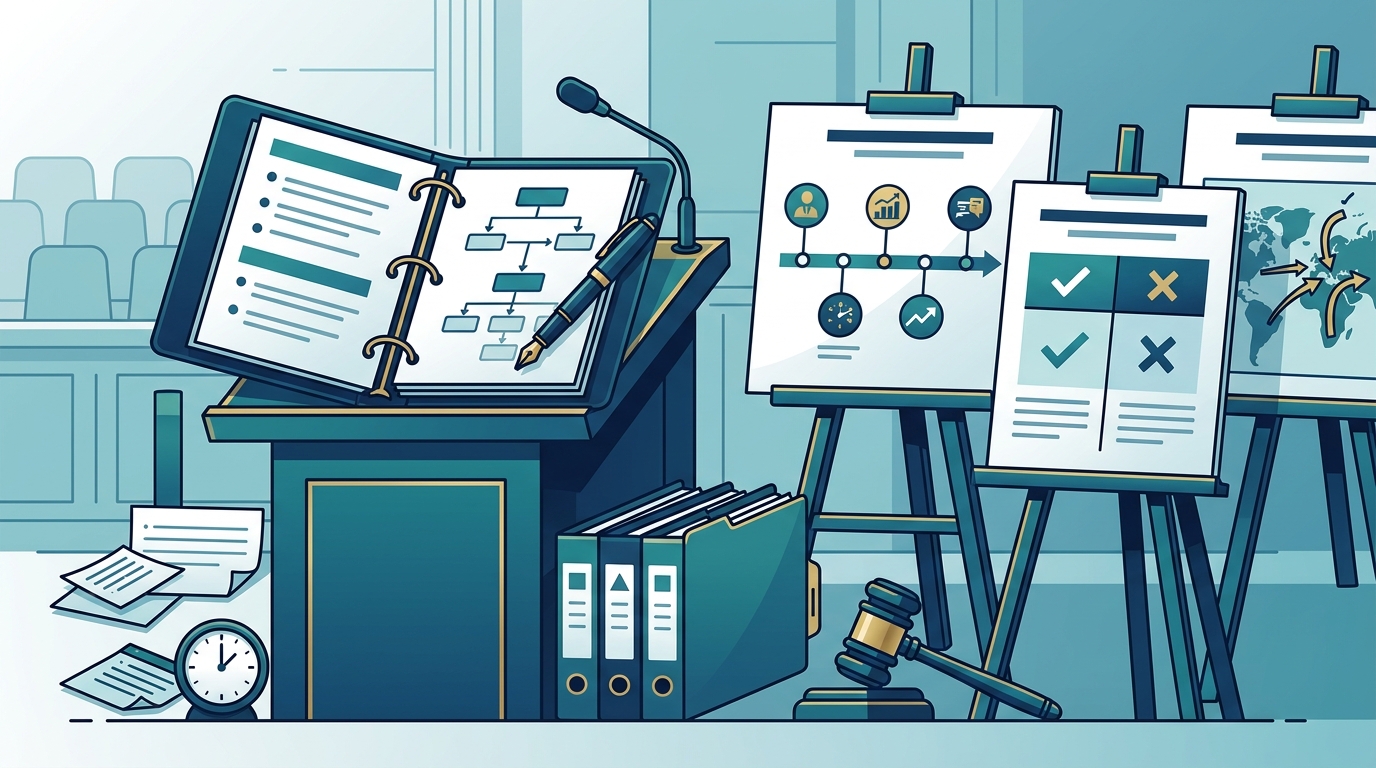
Trial graphics are visual tools such as timelines, charts, animations, and callout exhibits used to simplify complex evidence and reinforce key arguments. When polled at a federal judges' conference, virtually every judge indicated that the use of demonstratives was a critical part of any trial presentation.
A well-designed PowerPoint presentation during the opening does more than decorate the argument. It adds perceived competency, highlights documentary evidence through callouts, and creates a visual memory jurors carry into deliberations. Persuadius's case study on PowerPoint in opening statements found that the visual presentation clearly substantiated the verbal argument and increased the persuasive value of the opening.
Rules for Effective Visuals
Keep each slide to one idea. If a graphic contains more than one concept, you need more slides, not a busier slide. Avoid cluttering visuals with dense text or bullet points. And always rehearse the technology so the presentation runs seamlessly; nothing undermines credibility faster than fumbling with a laptop in front of a jury.
Common Mistakes to Avoid
- Reading the statement: Practice several times and speak directly to the jury. Eye contact signals confidence and belief in the case.
- Overloading with detail: Too much information overwhelms jurors. Stick to the essential facts and save the deep dive for witness testimony.
- Being overly aggressive: Attacking the opposition too strongly in an opening makes you appear combative rather than credible.
- Skipping rehearsal: Top trial teams practice and refine an opening statement 100 or more times until it is perfectly delivered.
- Ignoring the theme: Every sentence should connect back to your one-sentence case theme to avoid a scattered impression.
Key Takeaways
- Up to 80% of jurors form their verdict opinion during the opening statement, making it the most consequential phase of trial.
- Lead with a one-sentence theme that captures the moral core of your case.
- Use narrative storytelling rather than dry chronology to engage jurors emotionally.
- Address case weaknesses early to build credibility through inoculation.
- Pair your verbal narrative with clear, focused trial graphics to reinforce memory and perceived competence.
- Practice your opening extensively; the best trial lawyers rehearse 100+ times.
- Never read your opening. Speak directly to jurors with eye contact and conviction.
Frequently Asked Questions
What is an opening statement in a trial?
An opening statement is the first presentation a lawyer makes to the judge or jury, providing a factual preview of the case and the evidence that will be introduced. It is not an argument but rather a roadmap that helps the trier of fact understand what to expect.
How long should an opening statement be?
Most effective openings run between 10 and 30 minutes. The length depends on case complexity, but brevity and clarity are almost always more persuasive than exhaustive detail.
Can you use visuals during an opening statement?
Yes. Most courts allow demonstrative exhibits such as PowerPoint slides, timelines, and charts during opening statements. Judges widely agree that well-designed visuals enhance comprehension and persuasion.
What is the difference between an opening statement and a closing argument?
An opening statement previews the evidence and tells the factual story, while a closing argument draws inferences from the evidence and urges a specific verdict. Opening statements should not be argumentative.
Why is storytelling important in an opening statement?
Storytelling engages jurors on an emotional level, making facts memorable and relatable. Narrative structure helps jurors organize information and recall key evidence during deliberations.
Should I address bad facts in my opening statement?
In most cases, yes. Voluntarily disclosing unfavorable facts, a technique called inoculation, builds trust with the jury and prevents the opposing side from using those facts as a surprise to undermine your credibility.
How many times should I practice my opening statement?
Elite trial lawyers and litigation consultants recommend rehearsing an opening 100 or more times. Practicing extensively ensures smooth delivery, natural pacing, and confident eye contact with jurors.
Strengthen Your Next Opening Statement
The opening statement sets the trajectory of the entire trial. Whether you need help developing your narrative, testing themes with mock jurors, or creating persuasive trial graphics, Persuadius's litigation consulting team has supported more than 10,000 cases over three decades. Schedule a consultation to start building an opening that wins before the first witness is sworn in.