
An opening statement is the first substantive presentation a trial attorney delivers to the judge or jury, setting the narrative framework for the entire case. Research widely cited among top trial consultants suggests that as many as 80 percent of jurors form their initial opinion about a case during opening statements. That statistic alone should convince every litigator to treat the opening as the single most important phase of trial. In this guide, we break down the psychology, structure, storytelling techniques, and visual strategies that separate winning openings from forgettable ones, drawing on insights from litigation consultants who have supported more than 10,000 cases nationwide.
Why Opening Statements Matter More Than You Think
The opening statement does far more than introduce your case. It establishes the lens through which jurors interpret every piece of evidence that follows. As trial lawyer Ira Mickenberg has noted, opening statements set the context in which jurors will evaluate all of the evidence during trial. Once that lens is set, it is remarkably difficult to change.
Juror attention peaks during opening statements. Unless a celebrity witness is on the stand, the judge and jury will never be more focused than they are during your opening. That window of maximum attention is your best chance to create an emotional connection and frame the narrative in your favor. Experienced litigation consultants invest more preparation time in the opening than in any other trial phase for precisely this reason.
The Psychology Behind Juror Decision-Making
The Primacy Effect
The primacy effect is a well-documented cognitive bias in which information presented first carries disproportionate weight. Jurors form a working hypothesis at the very beginning of opening statements, and that hypothesis shapes how they interpret every subsequent fact. If you are plaintiff's counsel, this means you need to set a strong theme immediately. If you are defense counsel, introduce the strongest counter-argument right away.
Confirmation Bias
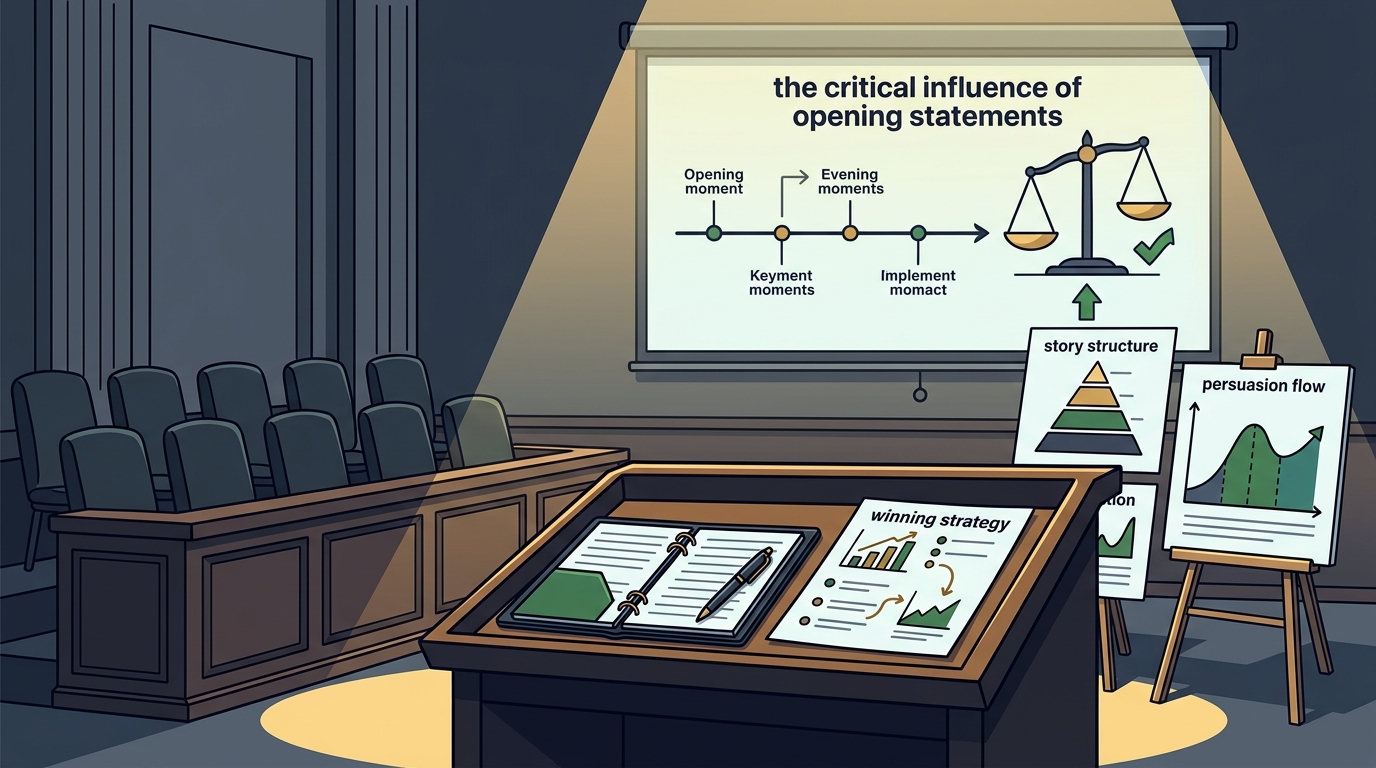
Confirmation bias is the tendency for people to favor information that supports their existing beliefs while ignoring contradictory evidence. Once jurors develop an initial leaning during your opening, they will spend the rest of trial looking for facts that confirm it. Tuning your opening to align with jurors' existing values and common-sense reasoning is therefore essential. Understanding these dynamics is a core focus of jury consulting for opening statements.
The 90-Second Rule
Research on first impressions shows that people decide within 90 seconds whether they like, trust, and feel comfortable around a new person. Your demeanor, tone, and opening words all contribute to that snap judgment, making the first moments of your opening statement critically important.
Storytelling Over Chronology
Studies and countless mock jury exercises confirm that deliberating jurors discuss a case as a story with a beginning, middle, end, and a full cast of characters. Yet many attorneys default to dry chronological recitations of facts. A narrative opening is a presentation approach that organizes evidence around human conflict and resolution rather than a timeline.
The American Bar Association and leading trial advocacy scholars alike emphasize that themes and storytelling make opening statements engaging and effective. Avoid reducing a story about broken promises into mere "breach of contract" language. Jurors live in the real world, so relate your case to that world.
How to Structure Your Opening Statement
There are several proven frameworks for organizing an opening. The table below compares three popular approaches used by top trial lawyers.
| Framework | Structure | Best For |
|---|---|---|
| Belief-Action-Benefit | State your core belief, the action you want, and the benefit of that action. Then elaborate and repeat. | Commercial litigation, IP cases |
| WHY-HOW-WHAT (Simon Sinek Model) | Lead with why the case matters, explain how events unfolded, then detail what happened. | Plaintiff personal injury, employment cases |
| Post-It / Mind Mapping | Brainstorm all ideas on individual notes, cluster into 5-6 groups, title each group as a chapter heading, then order them. | Complex multi-week trials with extensive fact patterns |
Whichever framework you choose, write the first few paragraphs first and ensure your trial consultant and you are on the same page before expanding. Keep the opening under 45 minutes; attention research and college-class scheduling both suggest that roughly 50 minutes is the upper limit of sustained focus for most adults.
Using Trial Graphics and Visual Aids
A well-designed PowerPoint presentation does more than decorate an opening. It adds perceived competency and depth while reinforcing key facts visually. Litigation graphics consultants routinely iterate through 30 or more versions of an opening-statement deck, sometimes exceeding version 90 for high-stakes matters.
Effective visual aids for opening statements include timelines that clarify the sequence of events, document call-outs that highlight critical contract language or emails, and simple charts that summarize damages. Static boards that remain visible throughout the opening are particularly effective for reinforcing key points without overwhelming jurors. Learn more about how PowerPoint presentations enhance opening statements in practice.
One crucial rule: relinquish the clicker. Let a trained trial technician advance your slides so you can maintain eye contact with the jury and stay in the flow of your narrative.
Practice, Rehearsal, and Mock Testing
The best trial lawyers practice their opening statement 100 or more times over the course of months. That level of rehearsal is not excessive; it is the standard among attorneys who consistently win. Memorize as much of the opening as possible using techniques like the memory palace method, acronym structures, or sequential numbering.
Practice on the exact computer and presentation setup you will use at trial. Technology failures during opening statements are more common than most attorneys realize, and they can undermine credibility in seconds. Beyond solo rehearsal, testing your opening with a mock jury or mock judge panel provides feedback that no amount of internal review can replicate. Mock jurors reveal which themes resonate, which arguments fall flat, and where your story has gaps.
Common Opening Statement Mistakes to Avoid
- Reading from a script: This signals lack of confidence and familiarity. Speak directly to the jury with eye contact.
- Overloading with detail: Stick to high-level themes. You will have the rest of trial to present granular evidence.
- Skipping damages (plaintiff): Always introduce damages during the opening so jurors begin anchoring on your number.
- Ignoring inoculation: Anticipate your opponent's strongest arguments and address them preemptively.
- Using bullet-point slides: Scientific evidence confirms that bullet points undermine persuasion. Use visual storytelling instead.
- Failing to practice with your trial tech: Rapport between the attorney and the hot-seat operator is essential for seamless delivery.
Key Takeaways
- Up to 80% of jurors form their initial case opinion during opening statements, making this the highest-leverage moment of trial.
- The primacy effect and confirmation bias mean the first facts and themes you present will shape juror perception throughout the case.
- Narrative storytelling consistently outperforms chronological recitation in juror recall and persuasion.
- Keep your opening under 45 minutes and structure it around no more than five or six core themes.
- Use professionally designed trial graphics to reinforce your narrative and convey competence.
- Practice your opening 100+ times and always rehearse on the actual trial technology setup.
- Test your opening in a mock trial setting to identify weaknesses before the real jury hears it.
Frequently Asked Questions
How long should an opening statement be?
Most experienced trial consultants recommend keeping an opening statement under 45 minutes. Attention research shows that audiences begin to disengage after roughly 50 minutes, similar to why many college classes and TV episodes are scheduled in that range.
What percentage of jurors decide the case during opening statements?
It is widely reported that as many as 80 percent of jurors form their initial opinion during opening statements. While no single quantitative study has confirmed this exact figure, the consensus among top litigation and jury consultants is that winning the opening is critical to winning the case.
Should I use PowerPoint slides during my opening statement?
Yes. A well-designed presentation reinforces your narrative, increases perceived preparation, and improves juror recall of key facts. Avoid bullet-point-heavy slides; instead, use visuals like timelines, document call-outs, and thematic imagery. Persuadius's litigation graphics team routinely creates 30+ versions per opening.
What is the primacy effect in the context of trial?
The primacy effect is a cognitive bias where information presented first carries the most weight in forming opinions. In trial, this means the themes and facts you introduce at the start of your opening will disproportionately influence how jurors interpret all subsequent evidence.
Should I address bad facts in my opening statement?
In many cases, yes. Proactively addressing weaknesses, a technique known as inoculation, builds credibility and reduces the impact when opposing counsel raises those facts later. However, this is a strategic decision that should be evaluated on a case-by-case basis, ideally with input from a trial consultant.
Why should a trial consultant help draft my opening statement?
Trial consultants bring years of cross-case experience, a fresh perspective free from case tunnel vision, and expertise in juror psychology. They know what themes resonate with real jurors because they test openings in mock trial settings regularly. Firms like Persuadius have supported the development of thousands of opening statements across all practice areas.
How many times should I practice my opening statement?
Top trial lawyers practice their opening 100 or more times. This level of rehearsal ensures fluid delivery, strong eye contact, and the ability to adapt if something unexpected happens in the courtroom.
What role does a trial technician play during opening statements?
A trial technician, also called a hot-seat operator, manages all courtroom technology during your presentation. They advance slides, display exhibits, and troubleshoot any technical issues so you can focus entirely on communicating with the jury. Practicing with your trial tech beforehand is essential for seamless delivery.
Get Expert Help With Your Next Opening
Your opening statement is the most important 45 minutes of your entire case. Do not leave it to chance. Persuadius has helped litigators from all major U.S. law firms craft and refine winning opening statements across more than 10,000 matters. Whether you need jury consulting, trial graphics, or a full mock trial, our team of attorneys, psychologists, and designers is ready to help.
Request a free consultation today and let us help you win the room before the first witness takes the stand.